
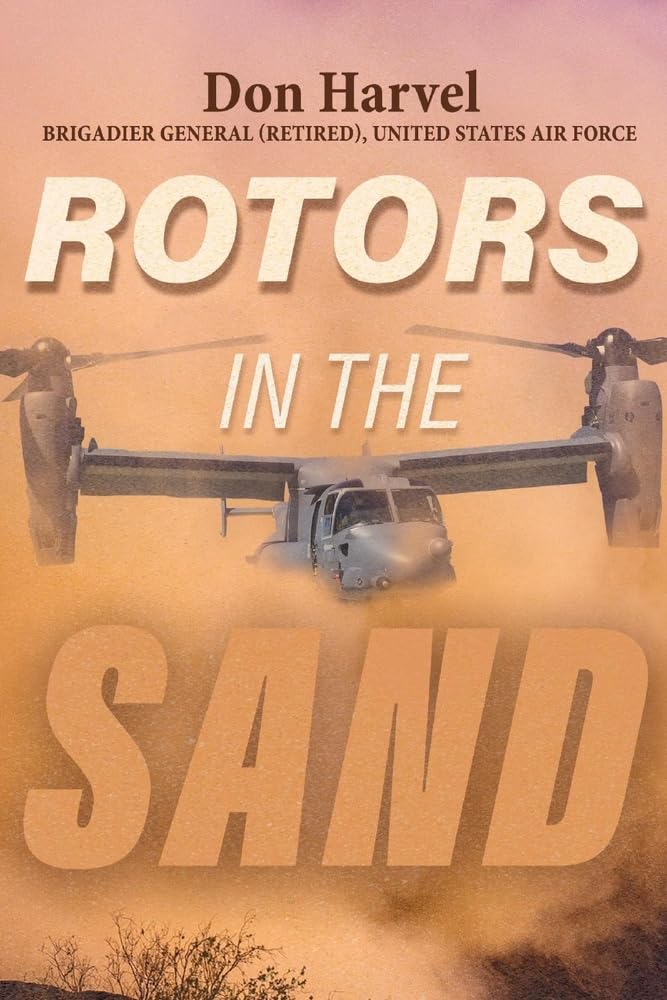
Rotors In The Sand
Product details
| Management number | 237099282 | Release Date | 2026/07/10 | List Price | $6.97 | Model Number | 237099282 | ||
|---|---|---|---|---|---|---|---|---|---|
| Category | |||||||||
April 9, 2010 Approximate Local Time – Midnight in Afghanistan Twenty-five hundred feet over Taliban-held territory in southern Afghanistan, three U.S. Air Force CV-22 Osprey tilt-rotor aircraft droned through the inky black sky. The mission of the forty-eight U.S. Army Special Forces, Third Battalion, Seventy-Fifth Rangers aboard the airplanes was to engage in direct action with the enemy. The Air Force crews' mission – insert the Army troops close to their objective, a landing zone (LZ) near the town of Qalat in eastern Afghanistan. Major Randell Voas, a Minnesota native and twenty-year veteran commanding military helicopters, led the three-ship formation on the planned fourteen-minute trip. With a layer of high clouds obscuring the night sky, screens on his instrument panel burned green with aircraft performance and navigation information, the only visible illumination.In the cockpit, the navigation page revealed their progress – late. Anticipating the descent for landing, Voas adjusted his night vision goggles and keyed the microphone switch on his control column advising his formation of an updated time over target (TOT). The new TOT would have the three CV-22s landing on the LZ at forty minutes after midnight. Approximately twenty miles from the LZ, Voas reduced power, allowing the nose of the aircraft to fall toward the obscured horizon. He trimmed pressure on the control stick to neutral for the gradual letdown to a lower altitude. Level at six hundred feet above the ground and two minutes out, an A-10 Thunderbolt II orbiting above illuminated (sparkled) the LZ. The crew, expecting a single shaft of light to identify their objective, instead watched multiple rays of infrared energy streak toward the planned touchdown point. The copilot leaned forward in his seat questioning what he saw. With no apparent concern, Voas acknowledged and modified his crosscheck, focusing on the TOT and the approach to landing. At three miles and one minute from landing, the trio of aircraft descended to three hundred feet above the ground. The troops in the rear of the airplane acknowledged the "one-minute" advisory from the CV-22 tail scanner and took a knee facing the open ramp and door, preparing for a rapid egress once on the ground. Descending into a valley and drifting away from their desired track, the crew noted an unexpected wind shift and corrected their heading to remain on course. At two and a half miles to landing, Voas slowed to approach speed, and tilted the nacelles on the ends of the CV-22's stubby wings toward the vertical, altering their configuration from airplane to helicopter mode. The flight engineer lowered the landing gear. Hydraulic fluid compressed to 5000 psi (pounds per square inch) hissed through stainless steel lines to release the up locks fixing the landing gear assemblies into the wheel wells. Giant pistons ported fluid that extended the landing gear into position with an audible clunk. Suddenly, at one hundred feet above ground, the airplane's nose unexpectedly pitched earthward in a rapid rate of descent. Unable to arrest the aircraft's vertical velocity or his speed over the ground, and with the plane headed for the center of a deep gully, Voas elected to abandon a vertical helicopter landing in favor of a seldom-practiced emergency maneuver. With his speed slightly exceeding ninety knots, he opted to land like any fixed-wing airplane, rolling the wheels onto the desert floor. Nearing touchdown, and amid a cacophony of aural electronic altitude warnings, the tempo of cockpit conversation intensified. What caused the Osprey to suddenly fall out of the sky? Could Major Voas avert the pending disaster? The story of this accident would become a political lightning rod for over a decade. Read this exciting book to find out why. Read more
| ISBN10 | 1098303326 |
|---|---|
| ISBN13 | 978-1098303327 |
| Language | English |
| Publisher | BookBaby |
| Dimensions | 5.98 x 0.98 x 9.02 inches |
| Item Weight | 1.4 pounds |
| Print length | 400 pages |
| Publication date | May 20, 2020 |
Bestseller ranking
United States





Customers who viewed this product also viewed
Steering Wheels

Correction of product information
If you notice any omissions or errors in the product information on this page, please use the correction request form below.
Correction Request Form